Why the ✨ Study Glow-Up Planner Is Reshaping How Professionals and Creators Approach Intentional Growth
In an era where attention is fragmented, burnout is normalized, and “productivity” often masquerades as overwork, a quiet but powerful shift is underway: professionals, creators, entrepreneurs, and marketers are reclaiming agency—not just over their output, but over their evolution. At the heart of this movement is the ✨ Study Glow-Up Planner: not merely a stationery product, but a thoughtfully engineered system that bridges academic discipline with holistic self-development. Designed for those who treat learning as lifelong practice—not just students preparing for finals—this planner reflects a broader cultural recalibration toward integrated, values-aligned progress.
A Tool Born from Evolving Workflows and Conscious Consumption
The rise of digital overload has made analog intentionality more valuable than ever. While AI-powered task managers and calendar syncs dominate tech stacks, many knowledge workers report diminishing returns from hyper-automated tools that prioritize speed over reflection. What’s emerging instead is demand for tactile, human-centered systems—tools that don’t just log activity but invite meaning-making. The ✨ Study Glow-Up Planner responds precisely to this need. Its structure assumes that focus, wellness, and growth are interdependent—not sequential phases to be optimized in isolation.
Consider the freelance designer juggling client deadlines, skill-building courses, and boundary-setting practices. A traditional planner might silo “work tasks” from “self-care,” reinforcing false dichotomies. In contrast, the ✨ Study Glow-Up Planner weaves them together: a weekly spread includes space for mapping project milestones alongside hydration goals, mindset reflections, and even book review notes. This isn’t novelty—it’s alignment with evidence-based behavioral science showing that sustained performance hinges on psychological safety, intrinsic motivation, and regular self-assessment.
More Than Planning: A Framework for Identity-Based Habits
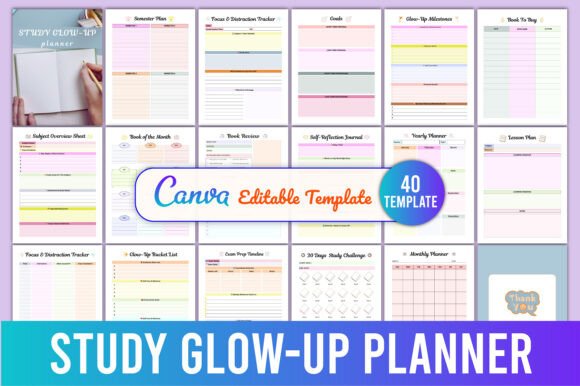
What distinguishes the ✨ Study Glow-Up Planner from generic productivity tools is its grounding in identity-based habit formation. Rather than asking “What should I do today?”, it invites users to ask “Who am I becoming?” through features like the Glow-Up Tracker and Self-Reflection Journal. These aren’t decorative add-ons—they’re deliberate scaffolds for narrative self-authorship, a concept increasingly validated in organizational psychology and adult learning theory.
For example, a marketing strategist using the planner might set a quarterly goal to deepen expertise in ethical AI use. Instead of tracking only hours spent reading or courses completed, they document shifts in perspective (“I now question data sources before designing campaigns”), note moments of creative confidence (“Pitched a privacy-first campaign idea without second-guessing”), and celebrate micro-wins (“Chose rest over late-night revisions—and delivered stronger work”). This kind of granular, values-rooted tracking mirrors trends in high-performing teams: Google’s Project Aristotle found psychological safety and shared purpose—not just efficiency metrics—were the strongest predictors of team success.
Design as Strategy: How Aesthetics Enable Consistency
In creative and entrepreneurial circles, aesthetics aren’t superficial—they’re functional. Visual coherence reduces cognitive load; personalization increases adherence. That’s why the ✨ Study Glow-Up Planner includes an editable Canva link alongside print-ready PDFs. This dual-format approach acknowledges how workflows vary: one user may prefer printing weekly spreads to pin above their desk, while another layers digital annotations over the PDF during virtual co-working sessions. Neither choice compromises integrity—the underlying architecture remains consistent.
This flexibility speaks directly to modern hybrid work realities. A content creator producing educational videos might use the Bookish Extras section to log pedagogical insights from each title they read, then repurpose those notes into script outlines. An entrepreneur building a coaching business could adapt the Lesson Planning pages to draft workshop modules—transforming personal study into scalable offerings. The planner doesn’t assume a single role or industry; it assumes growth is multidimensional and context-aware.
Self-Care as Strategic Infrastructure—Not Afterthought
“Self-care” has long been diluted into bubble baths and affirmations—a branding trope rather than operational practice. The ✨ Study Glow-Up Planner redefines it as infrastructure: measurable, scheduled, and inseparable from professional outcomes. Its Distraction Log, for instance, isn’t about shaming interruptions—it’s a diagnostic tool. Over time, patterns emerge: “I scroll most between 3–4 p.m. after back-to-back Zoom calls,” leading to adjustments like scheduling deep work earlier or adding a 10-minute movement break. This aligns with neuroscience research showing willpower is finite—but environmental design is renewable.
Likewise, the Wellness Wins tracker normalizes small, sustainable actions—tracking sleep consistency, hydration, or even “said no to one non-essential request”—as legitimate KPIs. For founders operating under chronic uncertainty, this reframing is vital. It moves well-being from aspirational to actionable, from “someday” to “this week’s priority.”
Academic Rigor Meets Creative Freedom
The planner’s Academic Planning section—class schedules, exam prep timelines, homework logs—might seem geared toward students. Yet its real power lies in transferability. A software engineer learning Rust can map syntax mastery like a syllabus; a copywriter auditing voice-and-tone principles can treat each module as a “course.” This mirrors the gig economy’s reality: continuous upskilling is no longer optional—it’s core infrastructure. The ✨ Study Glow-Up Planner provides the scaffolding to treat learning like a curriculum, not a chore.
Even its “Book of the Month” tracker transcends leisure. For a brand strategist, tracking how Toni Morrison’s narrative structures inform audience engagement strategies isn’t escapism—it’s applied research. The planner creates space for that synthesis, honoring intellectual curiosity as professional capital.
Privacy, Control, and Ownership in a Data-Saturated World
In an age of cloud-based dashboards and algorithmic nudges, the ✨ Study Glow-Up Planner offers something quietly radical: ownership. Its password keeper and contact list aren’t just conveniences—they’re assertions of autonomy. Users decide what stays private, what gets digitized, and how much friction they tolerate for security. This resonates with growing consumer skepticism toward opaque data practices, especially among creators who’ve experienced platform volatility firsthand.
Moreover, the printable format ensures longevity beyond app lifecycles or subscription renewals. A freelancer investing in the planner isn’t buying access to a service—they’re acquiring a durable, adaptable artifact. That durability matters when building a body of work meant to last decades, not quarters.
Conclusion: Planning as Practice, Not Prediction
The ✨ Study Glow-Up Planner succeeds not because it promises perfection—but because it honors process. It meets professionals where they are: navigating ambiguity, balancing multiple roles, and seeking growth that feels authentic, not extracted. Its popularity signals a maturing market—one that values tools calibrated for humanity, not just output.
As remote collaboration deepens, as AI handles more execution, and as audiences grow savvier about authenticity, the ability to articulate and embody intentional growth becomes a distinct advantage. Whether you’re refining your craft, launching a venture, or mentoring others, the ✨ Study Glow-Up Planner offers more than organization. It offers orientation—toward clarity, care, and the quiet confidence that comes from knowing your progress is visible, valued, and wholly yours.