Printable Savings Planner for Kids Canva
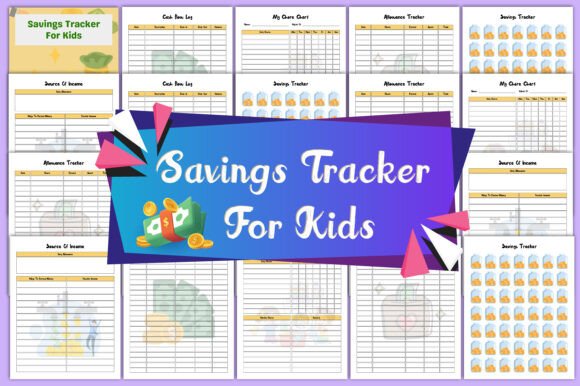
A well-designed Printable Savings Planner for Kids Canva isn’t just another digital download—it’s a strategic lever for creators, educators, and small business owners entering the planner printable market. Unlike static PDFs or generic templates, this Canva-editable resource delivers structure *and* flexibility: 122 pages of purpose-built financial literacy tools—Allowance Tracker, Savings Tracker, Cash Flow Log, Source of Income grid, Goal visualizer, My Chore Chart, and Notes—all optimized for real-world use with children aged 5–12. Its design reflects intentionality: CMYK color mode, 300 DPI resolution, no bleed, and standard 8.5 × 11-inch dimensions ensure professional print fidelity. More importantly, it’s built to scale—not just for personal use, but as a foundation for KDP interiors, classroom kits, or branded client resources.
Why This Planner Fits Strategic Gaps in Your Workflow
Most planners for kids focus on habit-building or basic counting. The Printable Savings Planner for Kids Canva bridges three under-served needs simultaneously: financial literacy scaffolding, creator efficiency, and customer outcome alignment. For educators, it transforms abstract money concepts into tactile, repeatable routines—tracking allowance alongside chore completion builds cause-and-effect understanding. For KDP publishers, its editable Canva link means rapid iteration: swap fonts, adjust colors to match brand guidelines, localize income categories, or add school-specific reward systems—without touching code or hiring a designer. For freelancers building client-facing financial education packages, it serves as a customizable starting point—no reinventing the wheel, just refining the message.
How to Use It With Purpose—Not Just Convenience
Editing in Canva is easy. Using the Printable Savings Planner for Kids Canva effectively requires clarity about your goal before opening the link. Ask yourself: Am I creating a product to sell? Supporting a curriculum? Building trust with parents through free value? Or developing a signature system for coaching families? Each objective changes how you engage with the template.
- If launching on KDP: Prioritize consistency over novelty. Use the existing layout logic—don’t flatten the Savings Tracker into a single page. Readers expect progression: weekly allowance → monthly savings goal → visual progress bar → reflection prompt. Preserve that rhythm. Add subtle branding (e.g., corner watermark, consistent header font) rather than overhauling sections. Test-print one full spread first—CMYK rendering can shift pastel tones unexpectedly.
- If adapting for classrooms: Leverage the “Chore Chart” and “Source of Income” pages as discussion anchors. A third-grade teacher might rename “Source of Income” to “Ways I Earn Tokens” and pair it with classroom jobs. The “Notes” section becomes space for teacher observations or student reflections—not just blank lines. Consider printing select pages double-sided to reduce paper use without sacrificing usability.
- If bundling for clients: Layer intentionality. Pair the planner with a 1-page guide titled “How to Talk to Your Child About Money”—not generic advice, but concrete scripts tied to each tracker. Example: When your child logs $5 from mowing the lawn, ask, “What part of this will go toward your bike goal? What part will you save for later?” That turns passive logging into active learning.
Risks of Using It Without Context
An editable template only amplifies your strategy—it doesn’t replace it. Relying on the Printable Savings Planner for Kids Canva without clarifying your audience’s real pain points leads to surface-level execution. A common misstep: assuming “more pages = more value.” But 122 pages mean little if users don’t understand *why* they’re filling out a Cash Flow Log versus an Allowance Tracker. Another risk is treating customization as decoration. Changing colors to match your Instagram palette matters less than ensuring the “Goal” page prompts specific, measurable targets (“Save $45 for Lego set by June 15”) instead of vague aspirations (“Buy something cool”).
Also consider operational friction. While Canva simplifies editing, it doesn’t automate distribution. If you’re selling this as a digital product, clarify file delivery expectations upfront: Do buyers receive only the Canva link? Is there a downloadable PDF version for those who prefer printing without logging in? Does your KDP interior include instructions on how to personalize it—or do buyers need prior Canva familiarity? These aren’t minor details. They shape perceived value, support load, and long-term reviews.
Design Choices That Signal Thoughtful Execution
The specifications of the Printable Savings Planner for Kids Canva reveal deliberate decisions—not defaults. CMYK color mode signals preparation for commercial printing, not just screen viewing. 300 DPI ensures crisp text and clean lines when printed at home or offset. No bleed accommodates standard home printers, lowering the barrier to entry for parents and teachers. Even the inclusion of both “Chore Chart” and “My Chore Chart” suggests layered utility: one for shared family tracking, the other for individual ownership.
That attention to detail translates directly to credibility. When a parent sees a planner that handles real logistics—like distinguishing between cash-in-hand income and gift-based savings—they infer competence. When a KDP buyer notices consistent spacing, logical page order, and typography hierarchy, they’re more likely to trust your next launch. In creator markets, perceived professionalism compounds quickly. You’re not just selling a planner—you’re signaling reliability, user empathy, and operational awareness.
Long-Term Positioning Beyond the First Sale
Treat the Printable Savings Planner for Kids Canva as a node—not an endpoint—in your broader content architecture. Its true strategic value emerges when connected to other assets. For example:
- Use the “Goal” page as a lead magnet: Offer a single printable page in exchange for email sign-ups, then nurture subscribers with short videos showing how to use the full planner.
- Turn the “Cash Flow Log” into a workshop activity: Host a 45-minute virtual session for homeschoolers where families fill it out together live—and position your full planner as the follow-up tool.
- Repurpose the “Notes” section into a blog series: Publish weekly reflections like “What My Child Wrote in Their Savings Planner This Week (And What It Taught Me)” to humanize financial education and drive organic search traffic.
This isn’t about stretching one product thin. It’s about using a well-structured, editable foundation to deepen relationships, demonstrate expertise, and create natural expansion paths—whether that’s a companion budgeting journal for teens, a Spanish-language version, or a simplified version for early learners.
Before You Edit—Ask Three Questions
Before clicking “Edit in Canva,” pause and answer these honestly:
- Who specifically benefits from this change? Not “people who like planners,” but “a busy single parent managing two part-time incomes and wanting to teach her 8-year-old delayed gratification without daily negotiation.”
- Does this edit improve clarity, reduce friction, or strengthen alignment with a stated goal? If you’re adding a “Rainy Day Fund” box to the Savings Tracker, does it map to a real behavioral outcome—or is it just extra ink?
- What happens if someone uses this exactly as-is, with zero edits? If the answer is “they’ll still get meaningful results,” you’ve landed on solid core functionality. Build outward from there—not inward from aesthetics.
The Printable Savings Planner for Kids Canva works best when treated as infrastructure—not ornamentation. Its power lies not in what it looks like, but in how reliably it supports decisions, conversations, and habits that last longer than a single school year or Amazon sales cycle. That kind of durability doesn’t come from trend-chasing. It comes from aligning every page with a human need—and every edit with a clear outcome.