🌞 Summer Planner for Kids: More Than Just Fun—A Tool That Builds Lifelong Skills
Summer shouldn’t just be about downtime—it’s a golden opportunity for growth, discovery, and gentle structure. But how do you balance freedom with purpose for kids aged 5–12? Enter the 🌞 Summer Planner for Kids: a thoughtfully designed, interactive activity planner that turns sunny days into meaningful moments—without feeling like school in disguise.
Why Structure Matters (Even in Summer)
Many parents assume summer means zero schedules—but research and real-world experience show otherwise. Children thrive when they have rhythm, even if it’s flexible. A predictable flow helps reduce anxiety, builds confidence through small wins, and supports executive function development—the mental skills behind planning, focus, and self-control. The 🌞 Summer Planner for Kids doesn’t impose rigid rules. Instead, it offers scaffolding: visual, playful, and age-appropriate tools that let kids *own* their time.
Think of it like training wheels for independence. A 6-year-old might use the daily routine chart to remember to brush teeth, pack a water bottle, and choose one “big thing” to do before lunch. A 10-year-old might use the same page to plan a bike ride, practice piano, and draft a postcard to Grandma—all while checking off each step with pride.
What Makes This Planner Truly Kid-Centered?
Not all planners are created equal—especially when designed for children. The 🌞 Summer Planner for Kids stands out because every feature begins with how a child thinks, learns, and expresses themselves—not how adults wish they would.
📘 “About Me” Page: Where Identity Takes Shape
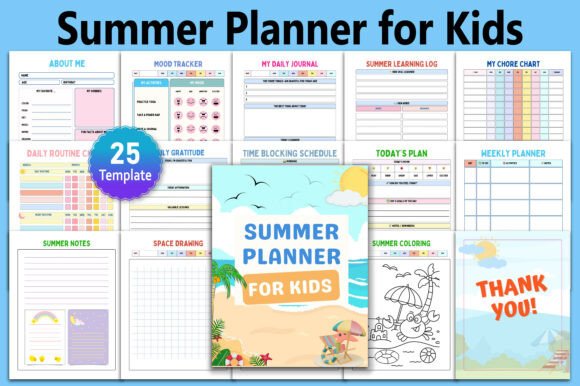
This isn’t filler. It’s the first invitation to self-awareness. With prompts like *“My superpower is…”*, *“I feel happiest when…”*, and *“One thing I want to try this summer is…”*, kids begin connecting feelings to actions and interests to goals. Teachers and therapists often use similar exercises to support social-emotional learning—and now families can bring that power home, casually and joyfully.
🕒 Daily Routine Time Blocking Charts: Visual Clarity, Real Choice
Kids don’t think in abstract hours—they think in “after breakfast,” “before swimming,” or “when the sun goes down.” The time blocking charts use simple icons and color zones (morning = yellow, afternoon = blue, evening = lavender) so children can see their day at a glance. They decide where to place “reading time,” “free play,” or “helping make dinner”—building decision-making muscle alongside consistency.
Pro tip: Pair this with a physical analog clock or a visual timer. Watching time become tangible reinforces understanding far more than digital screens ever could.
✅ Weekly Planner To-Do Lists: Big Picture, Small Steps
Long-term thinking is hard for young minds. The weekly spread breaks it down: three “Big Goals” (e.g., “Learn to whistle,” “Grow basil from seed,” “Read two chapter books”), plus space for “Fun Things I Did” and “Things I Tried.” There’s no penalty for unfinished items—just celebration for effort. That mindset shift alone makes summer feel expansive rather than pressured.
🎯 Today’s Plan Goal Setting: Mindful Moments, Not Just Tasks
This daily page is where intention meets reflection. Alongside “Top 3 Goals,” there’s a mood check-in (emoji scale + space to draw or write), a reminder box (“Don’t forget your sunscreen!”), and a “Favorite Moment” prompt. It gently teaches emotional literacy and memory anchoring—skills that support resilience long after summer ends.
🌟 Daily Gratitude Journal: Rewiring the Brain, One Sunny Sentence at a Time
Gratitude isn’t just warm fuzziness—it’s neuroscience-backed wellness. Studies show regular gratitude practice strengthens neural pathways linked to optimism and stress regulation. In the 🌞 Summer Planner for Kids, prompts like *“I’m grateful for…”*, *“Today I learned…”*, and *“Someone who helped me was…”* invite authentic, unforced reflection. No forced positivity—just space for noticing good things, big and small.
Where Creativity and Calm Coexist
Let’s talk about the pages that don’t look like “work”—but do some of the heaviest lifting:
- Mood trackers with expressive faces and color-coded days help kids name emotions before they escalate.
- Screen time logs aren’t about restriction—they’re about awareness. “How did I feel before and after watching that show?” sparks real conversation.
- Reading logs include space for book covers, favorite characters, and whether the story made them laugh, cry, or wonder.
- Doodling zones and coloring pages aren’t decoration—they’re cognitive warm-ups, calming transitions, and outlets for ideas that haven’t found words yet.
These aren’t add-ons. They’re integrated design choices rooted in child development principles—supporting regulation, expression, and curiosity all at once.
Learning That Feels Like Play
The 🌞 Summer Planner for Kids includes a Summer Learning Log Activity Tracker—but notice the language: it’s not “homework log” or “academic review.” It’s about tracking *new words heard*, *skills practiced*, *experiments tried*, and *questions asked*. A child might log: “Learned ‘photosynthesis’ while watering tomatoes,” “Built a fort using 7 pillows and 3 blankets,” or “Asked Dad why clouds float.”
This reframes learning as something alive, personal, and happening everywhere—not just behind a desk. It aligns perfectly with modern educational values: project-based, interest-led, and deeply connected to lived experience.
Real Families, Real Results
In homes across the U.S. and Canada, parents report shifts within days: less morning resistance, fewer “I’m bored” declarations, more initiative around chores and hobbies. One mom shared how her 7-year-old started using the gratitude page to write thank-you notes to neighbors who shared garden produce. Another dad said his 9-year-old began setting alarms for “reading time”—not because he was told to, but because he wanted to finish his book.
It works because it meets kids where they are—not where we wish they’d be.
Choosing the Right Planner Isn’t Just About Pages—It’s About Purpose
Before buying any planner, ask: Does it empower choice? Does it honor developmental stages? Does it leave room for mess, change, and surprise? The 🌞 Summer Planner for Kids answers yes—to all three. It’s printed on thick, lay-flat paper for easy coloring and writing. It’s spiral-bound so pages stay open while little hands flip, draw, and plan. And it’s intentionally undated—so families can start anytime, pause for vacation, and pick up again without guilt.
There’s no “right” way to use it. Some families fill it together every Sunday night. Others let kids take full ownership by Friday afternoon. Some use only the gratitude and goal pages. Others dive into every tracker. Flexibility isn’t a feature—it’s the foundation.
More Than a Planner—A Summer Companion
At its heart, the 🌞 Summer Planner for Kids is a quiet act of belief: belief that children are capable, curious, and worthy of tools that help them navigate time, emotion, and growth—with joy as the compass. It doesn’t erase spontaneity. It makes space for it—by giving structure that breathes, creativity that counts, and reflection that feels like play.
So whether your summer means backyard camping, road trips, library visits, or slow mornings with popsicles and picture books—the 🌞 Summer Planner for Kids grows with your family’s rhythm. Not as a taskmaster, but as a friendly guide holding space for all the ways childhood blooms in the sun.