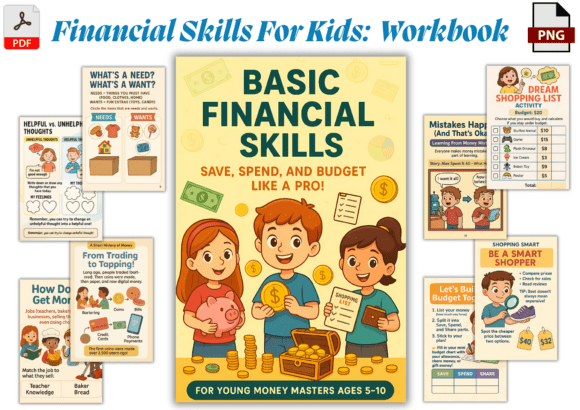
Basic Financial Skills for Kids
Teaching kids about money doesn’t have to mean dry lectures or confusing charts. Basic Financial Skills for Kids is a thoughtfully designed, 25-page printable book that turns foundational money concepts into joyful, hands-on learning — especially for children aged 5 to 10. It’s not just about counting coins. It’s about building confidence, making thoughtful choices, and developing habits that last well beyond childhood.
What Makes This Resource Different?
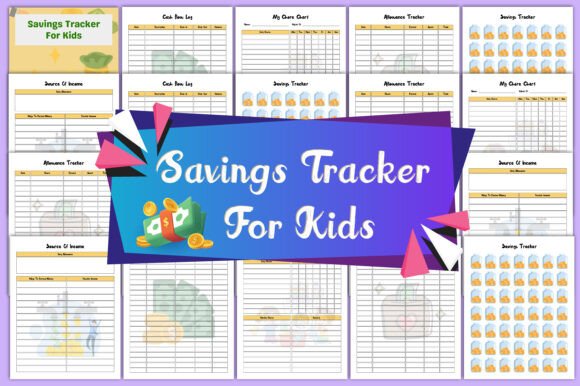
Unlike generic coloring sheets or oversimplified flashcards, this printable book bridges theory and real life. Each page supports a core financial idea — saving, spending, budgeting, sharing, and banking — using age-appropriate language, friendly illustrations, and concrete examples. A child might track their weekly allowance with the Allowance Tracker, compare prices in the Smart Shopper Game, or dream big (and plan realistically) with the Dream Shopping List. These aren’t abstract exercises — they mirror decisions kids encounter daily: “Should I buy this toy now or save for something bigger?” or “How can I use part of my money to help someone else?”
Why Parents, Teachers, and Caregivers Choose It
Many adults want to raise financially aware kids but aren’t sure where to start — or how to keep it engaging. That’s where Basic Financial Skills for Kids helps fill the gap. It gives grown-ups a ready-to-use, no-prep tool that feels like play but delivers real understanding. For homeschoolers, it slots neatly into weekly life skills blocks. In classrooms, teachers use it during morning meetings, math centers, or social-emotional learning time. Summer programs and after-school clubs appreciate how easily it sparks conversation and reflection — without requiring special materials or tech.
Practical Uses Across Real-Life Settings
- Homeschooling: Print one copy per child and bind it into a personal finance journal. Reuse pages year after year — just print fresh worksheets as needed.
- Classrooms: Use individual pages as station activities — pair the Good Money Habits Checklist with role-play scenarios, or turn the Budget Bingo page into a small-group challenge.
- Therapy & Counseling: Some counselors use the Personal Money Planning pages to support executive function development, especially for kids working on planning, impulse control, or goal-setting.
- Community Programs: Libraries and youth centers print multiple copies for workshops — the glossary and cheat sheet make facilitation smoother, even for non-finance experts.
- Digital Creators & Educators: Bloggers and curriculum designers incorporate the PNG files into custom slide decks, digital planners, or membership resources — the clean 6x9 layout ensures readability on tablets and printed handouts alike.
What’s Inside — Beyond the Basics
The 25-page structure is intentional and progressive. Early pages introduce what money *is* and where it comes from (allowances, gifts, chores). Then it gently layers in decision-making: “What happens when I spend all my money right away?” Later pages invite reflection — “What does ‘enough’ mean?” — supported by tools like the Share Jar Tracker and Wants vs. Needs Sorting Cards. The included glossary defines terms like *budget*, *interest*, and *donate* in kid-friendly language. A completion certificate adds celebration and motivation, while bonus worksheets offer extension ideas — like designing a family savings goal chart or mapping out a “rainy day fund” for a favorite toy.
Simple but Thoughtful Design Choices
The 6x9 inch size isn’t arbitrary. It fits comfortably in small hands, works in standard binders or pocket folders, and prints clearly on home printers — no scaling or cropping needed. The vertical orientation mirrors how kids naturally hold books and tablets, supporting focus and reducing visual overwhelm. Bright, inclusive illustrations show diverse kids making real choices — choosing between snacks, saving for a pet, or helping a friend — reinforcing that money skills belong to everyone.
Things to Keep in Mind Before You Begin
This resource works best when paired with everyday moments — not isolated lessons. A worksheet on “smart shopping” gains meaning when followed by a trip to the grocery store. The Allowance Tracker becomes powerful when tied to a consistent, transparent system at home. Also, remember that kids learn through repetition and modeling: if they see adults pausing before purchases, discussing trade-offs, or talking about giving, the pages come alive faster.
It’s also worth noting that the PDF and PNG formats serve different needs. The PDF is ideal for printing full workbooks or sharing digitally with families. The individual PNGs give flexibility — you can drop a single page into a Google Slides lesson, overlay it on a Canva template, or import it into a learning management system. Both versions maintain crisp, high-resolution quality — no blurry text or faded colors.
Real Impact, Measured in Small Wins
You won’t hear a five-year-old recite compound interest formulas — and that’s not the goal. Instead, you might notice them pause before grabbing a second candy bar, ask to add something to their “dream list,” or proudly show you their filled-in Good Money Habits Checklist. Those are signs the ideas are sticking. One third-grade teacher shared how her students started using the “Wants vs. Needs” sorting game during lunch debates — turning peer conversations into gentle, collaborative reasoning. Another parent reported that after two weeks with the Allowance Tracker, her eight-year-old began suggesting ways to stretch their money further — like waiting for a sale or choosing a less expensive alternative.
That’s the quiet power of Basic Financial Skills for Kids: it meets children where they are, uses what they already care about (toys, treats, helping others), and builds competence step by step — no pressure, no jargon, just steady, joyful growth.