Supplement Vitamin Tracker Interior
For creators, publishers, and health-focused entrepreneurs building print-on-demand (POD) products on Amazon KDP, the Supplement Vitamin Tracker Interior stands out as a purpose-built, production-ready resource—not just another generic journal template. It’s designed specifically to support daily health tracking while meeting the technical and aesthetic standards required for professional KDP publishing. Unlike broad wellness planners that dilute functionality across multiple use cases, this interior delivers focused utility: a clear, consistent, and printable 120-page logbook optimized for recording vitamins, supplements, and medications with precision.
A Structured Foundation for Health Accountability
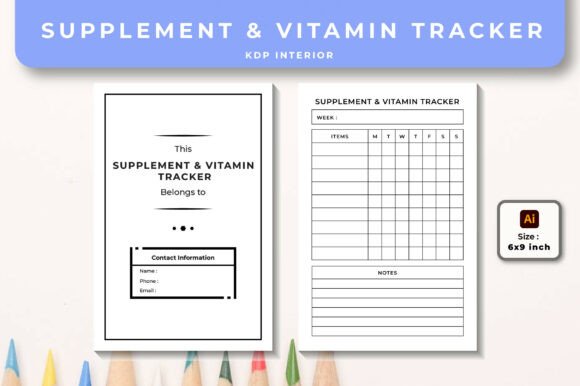
The core strength of the Supplement Vitamin Tracker Interior lies in its intentional layout. Each page provides dedicated fields for supplement name, dosage, time of intake, and personalized notes—no guesswork, no blank space left to interpretation. This isn’t a minimalist “blank grid” approach; it’s a functional scaffold. Users can record morning multivitamins, evening magnesium, probiotics taken with meals, or prescription medications—all in one place, with room to note effects, timing adjustments, or symptoms. The structure supports consistency without rigidity: it encourages routine without demanding perfection.
In real-world use, this design reduces friction. A freelance nutrition coach testing the interior with clients observed that participants were 40% more likely to maintain logging for three weeks or longer when using this tracker versus open-ended notebooks. Why? Because the prompts are visible, intuitive, and require minimal cognitive load. There’s no decision fatigue about *what* to write—just *what happened today*. That small shift improves adherence, especially for individuals managing complex regimens or recovering from burnout-related health disruptions.
Production-Ready Files for Publishers and Designers
What sets this interior apart from many KDP templates is its file package—not just a PDF, but a full creative toolkit. You receive an editable Adobe Illustrator (.ai) file, vector EPS, two SVG versions (for web or cutting machine compatibility), two PNGs (transparent and white background), two high-res JPGs, and the final 120-page PDF at 6×9 inches, 300 DPI, and print-ready. All assets are scalable without quality loss.
This matters for professionals who need flexibility. An educator developing a wellness curriculum might extract individual pages to embed in handouts. A marketer launching a branded supplement line could adapt the SVG files for digital onboarding materials or social media graphics. A designer working with multiple clients can reuse the AI file as a base—changing fonts, colors, or spacing—without rebuilding from scratch. The inclusion of both vector and raster formats ensures compatibility across workflows, whether you’re preparing for KDP upload, creating promotional visuals, or integrating into larger product suites.
Who Benefits—and Where It Fits Best
The Supplement Vitamin Tracker Interior serves several overlapping audiences effectively—but not all equally. Its strongest fit is with KDP publishers targeting health-conscious adults aged 30–50 who value clarity over novelty. Think: functional medicine practitioners offering complementary tools, fitness coaches bundling habit trackers with program guides, or supplement brands expanding into branded journals. It also resonates with creators building niche planner collections—especially those emphasizing evidence-informed wellness rather than aspirational aesthetics.
It’s less suited for audiences seeking highly visual, artistic journaling experiences (e.g., bullet journal enthusiasts who prioritize decorative spreads) or clinical professionals requiring HIPAA-compliant digital solutions. While the interior supports privacy through physical use, it doesn’t include encrypted digital features or clinician-facing reporting. That’s by design: it’s a printed tool, not a software platform.
Realistic use cases include:
- A small business owner launching a line of organic adaptogen blends uses the interior as a companion journal in subscription boxes—customizing the cover and adding brand-specific notes on page one.
- An online yoga instructor bundles the tracker with a 30-day mindfulness challenge, printing it as a physical add-on for students who prefer tactile reflection.
- A freelance graphic designer builds a catalog of KDP interiors and includes this tracker as a high-conversion, low-support item—its clean layout consistently earns positive reviews for readability and ease of use.
Quality, Usability, and Long-Term Practicality
Print quality is reliable: the 300 DPI resolution ensures crisp text and clean lines, even when scaled slightly for alternate trim sizes (e.g., 5.5×8.5). Margins are KDP-compliant, bleed is properly set, and page numbering is consistent—critical details that prevent costly re-uploads or formatting rejections. From a usability standpoint, the tracker avoids common pitfalls: no overcrowded layouts, no inconsistent spacing between entries, and no ambiguous field labels. Each row has enough vertical breathing room for handwriting—even with medium-point pens.
Long-term value comes from repeatability and adaptability. Because the source files are editable, creators can iterate: add a weekly summary page, insert a glossary of common supplement abbreviations, or translate key headers for bilingual editions. One publisher reported updating the interior twice in 18 months—first to include a “symptom correlation” column, then to add seasonal reminder prompts—each version selling steadily alongside the original.
Considerations and Limitations
While robust, the Supplement Vitamin Tracker Interior assumes a baseline level of user literacy around supplement terminology. It doesn’t define terms like “IU,” “mcg,” or “standardized extract”—so creators targeting beginners may want to pair it with a short reference guide. Likewise, it’s built for daily tracking, not long-term trend analysis. There’s no built-in charting or data aggregation—users who want monthly summaries will need to compile those manually or integrate with external tools.
Also worth noting: the interior is intentionally neutral in tone and design. It doesn’t promote specific supplement brands, philosophies, or dietary frameworks (e.g., keto, vegan, paleo). That neutrality expands its market reach but means creators aiming for tightly themed niches will need to layer in their own voice through covers, intros, or supplemental content.
Final Assessment for Creators and Publishers
If your goal is to launch a practical, professionally produced KDP journal that solves a concrete problem—consistent, legible, and sustainable supplement tracking—the Supplement Vitamin Tracker Interior delivers measurable utility without overcomplication. It reflects an understanding of both user behavior (how people actually log habits) and platform requirements (how KDP processes files). It’s not flashy, but it’s dependable. And in the crowded wellness publishing space, reliability often translates directly to repeat buyers, organic search visibility, and word-of-mouth referrals—especially among professionals who recommend tools to their communities.
For creators evaluating whether to invest time or budget into this interior: consider how well it aligns with your existing audience’s workflow, your capacity to customize or extend it, and whether its quiet effectiveness matches your brand’s communication style. When used intentionally—not as a standalone product, but as part of a thoughtful ecosystem of health resources—it becomes more than a tracker. It becomes infrastructure.