Black White Lined Writing Paper
Black White Lined Writing Paper is more than a blank slate—it’s a deliberate, minimalist foundation for clarity and intention. The high-contrast black lines on crisp white paper eliminate visual noise while supporting rhythm, spacing, and structure. Unlike ruled paper with faint blue or gray lines, this version uses true black ink—sharp, legible, and designed to stand up to scanning, printing, and digital annotation without fading or bleeding. It’s built for people who value precision in communication, whether drafting a lesson plan, sketching a business model, journaling daily insights, or preparing client-ready copy.
Why Simplicity Works—Especially Now
In an era of constant visual overload, Black White Lined Writing Paper offers cognitive relief. The absence of color, texture, or decorative elements reduces decision fatigue. That means less time choosing fonts or adjusting margins—and more time thinking, refining, and acting. Educators use it to create clean handouts that students can read without distraction. Freelancers print it for client brainstorming sessions where legibility matters under fluorescent lights or on shared projectors. Bloggers repurpose the lined layout as a content outline template before moving into CMS editors. Even designers use it as a baseline for typography studies—testing line height, margin ratios, and paragraph breaks in real-world conditions.
Volume-6 Delivers Flexibility, Not Just Quantity
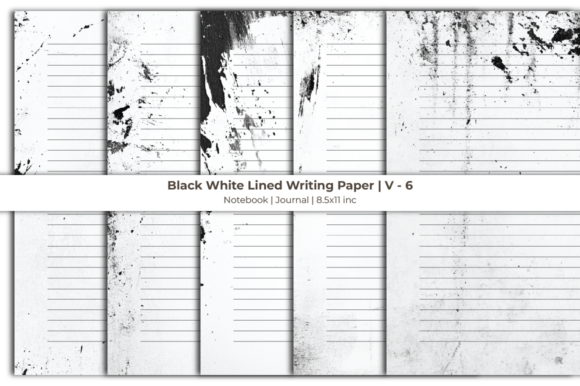
The Volume-6 Black White Lined Writing Paper collection isn’t about bulk—it’s about adaptability. Each set includes five distinct variations, all at standard 8.5 x 11 inches, optimized for US letter-size printers and most home office scanners. But what makes it truly useful is the file variety: one ZIP contains JPGs for quick social media posts or email previews, PNGs with transparent backgrounds for layering over branding assets, PDFs ready for immediate printing (with bleed-safe margins), and editable source files (typically layered PSD or AI) for custom tweaks—like adjusting line spacing from 0.3" to 0.4" for dyslexic readers or adding a subtle watermark for student submissions.
Creative Uses Across Roles
Different users find different value in the same sheet. Here’s how it translates across real-world needs:
- Educators: Print reusable worksheets—vocabulary builders, grammar drills, or reflection prompts—with consistent line height so handwriting stays aligned across grade levels. Use the PNG version to overlay onto interactive whiteboard lessons.
- Writers & Editors: Draft long-form pieces on printed copies, then scan and annotate digitally. The bold black lines hold up well under OCR tools, making handwritten edits easier to convert later.
- Small Business Owners: Create branded notepads by adding a small logo in the top corner of the PDF before printing. Or use the JPG version as a background in Canva for pitch deck slide notes.
- Hobbyists & Journalers: Combine with fountain pens or fine-liner markers—the high-contrast lines guide ink flow without competing visually. Try using one sheet per habit tracker column, then bind them weekly into a simple booklet.
- Marketers: Repurpose the lined layout as a script template for video voiceovers—each line becomes a natural pause point. Export as PDF and share with remote voice talent who need clear formatting cues.
Staying Organized Without Overcomplicating
Clarity starts with consistency—not complexity. With Black White Lined Writing Paper, organization happens through repetition, not decoration. Keep your workflow tight by assigning one variation per purpose: use Variation 1 for daily planning, Variation 3 for client feedback forms, Variation 5 for internal team meeting notes. Because all files are pre-sized and pre-spaced, you avoid last-minute scaling issues when switching between screen and print. And since the ZIP includes both raster and vector formats, you’re never locked into one tool—you can open the PDF in Acrobat, edit the PSD in Photoshop, or place the AI file directly into InDesign layouts.
Making It Your Own—Without Losing Function
Customization should serve intent, not distract from it. Before modifying the source files, ask: What problem am I solving? Need wider margins for binding? Adjust the artboard—not the line weight. Preparing materials for learners with visual processing differences? Lighten the black lines to 80% opacity instead of switching to gray (which reduces contrast). Adding a header? Keep it minimal—two lines max, left-aligned, 10 pt font. The goal isn’t to make it “unique”—it’s to make it work better for your specific audience and context. That’s how Black White Lined Writing Paper stays useful across projects, platforms, and years.
Realistic Tips for Getting Started
You don’t need a full creative overhaul to benefit. Start small:
- Download the ZIP and open the PDF first—print one page and test it with your usual pen or pencil. Notice how the line spacing feels under your hand.
- Pick one recurring task (e.g., weekly team updates, blog post outlines, or student feedback) and replace your current template with one of the five versions for two weeks.
- If you work digitally, drag the PNG into your note-taking app (like Obsidian or Notion) as a background image—then type or draw over it. You’ll see how the lines anchor your content without constraining it.
- When sharing with others, send the PDF—not the source file—unless they specifically need to edit. It ensures consistent rendering across devices and avoids font substitution surprises.
There’s no “right” way to use Black White Lined Writing Paper—only ways that align with how you think, teach, write, or build. Its strength lies in its restraint: no gradients, no watermarks, no forced branding. Just space, structure, and intention—ready the moment you open the file.